

A research team has identified genes enabling peaches and their wild relatives to tolerate stressful conditions – findings that could help the domesticated peach adapt to climate change.
Researchers have found that nitrogen-fixing legume trees can support themselves and surrounding trees not only with increased access to nitrogen but with other key nutrients through enhanced mineral weathering.
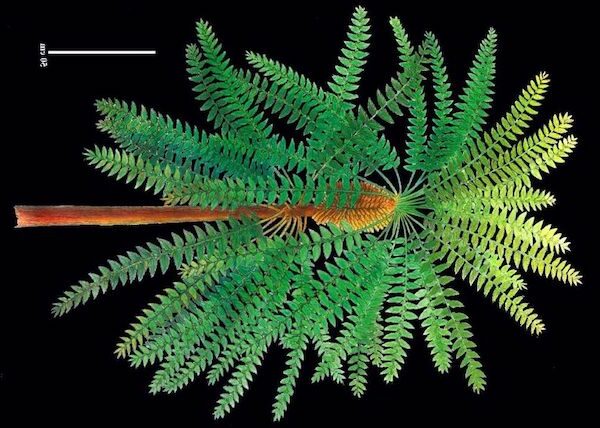
Spectacular fossil plants preserved within a volcanic ash fall in China have shed light on an evolutionary race 300 million years ago, which was eventually won by the seed-bearing plants that dominate so much of the Earth today.
Researchers have revealed the response mechanism of rhizosphere microorganisms of deep-rooted leguminous plant to water and nitrogen changes in desert ecosystem.
An impressive body of evidence published this week reveals the answer to a mystery that has puzzled plant scientists for more than 30 years: the role of the molecule suberin in the leaves of some of our most productive crops.…
Plants grow in two directions: the shoots of plants grow toward the light to make the best use of it, and the roots grow toward the center of the earth into the soil. A team has now been able to…
Researchers find that plant root tips are constrained to a dome shape, similar to that of an arched bridge, because of one-directional and localized tissue growth.
Commentary on Gobert et al. The authors prove the feasibility of an idea through this proof-of-concept work. As they point out, plant antiviral treatments are usually virus-specific, unfortunately for the moment a ‘broad-spectrum’ plant antiviral does not exist.
Like other plants, mistletoe is capable of using sunlight to create its own food, a process called photosynthesis. However, it prefers to siphon water and nutrients from other trees and shrubs, using “false roots” to invade its hosts.