Day 1 Travel: Overwhelming Anticipation
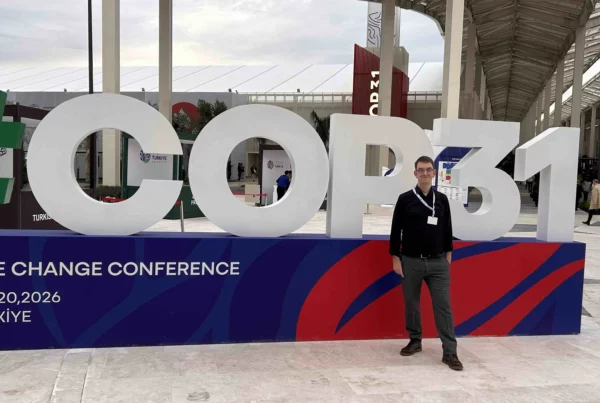
This week I have the honour of attending the United Nations Framework Convention on Climate Change (COP31) taking place in Antalya, Turkiye. The Global Plant Council (GPC) has accredited Observer status (NGO) for COP31, which means we can nominate representatives to attend the in-person meeting.
There will be198 countries represented at the table with approximately 100, 000 delegates.
It seems that COP31 is rather popular so only one daily place was allocated to the GPC… and the early reports of long queues for accreditation seem to speak to event popularity!
I will be attending from Nov 10-12 and my GPC colleague Deena Errampalli will attend Nov 13-19.
Although GPC represents a global cohort of up to 30,000 plant scientists, we are a financial and organisational minnow at this level and don’t have the resources to organise any specific events at COP31.
GPC Policy Reports
However, GPC has published three Policy Reports that highlight the importance of future plant science research for the mitigation of human-induced climate change.
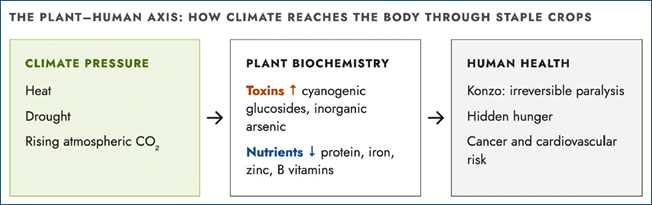
The first GPC report highlights the OneHealth implications of not supporting plant science. We report that the metabolism of two staple crops is significantly impacted by higher temperatures. Plant science research has demonstrated that in higher temperatures, a rice crop will exhibit a major reduction in nutrient-load, including in levels of folate, which will significant impact the health of 600 million vulnerable people. Importantly we highlight the importance of measuring nutrient quality in crops and not only the quantity of grain produced under difference climate conditions.
Secondly, we highlight that when Cassava is grown under higher temperatures, it produces an undetectable increase of cyanide, which in turn causes increased incidence of Konzo, a severe debilitated disease.
It is important to highlight these cases as they demonstrate that climate changes is directly impacted human health through the alteration of staple crops.
You can find here the OneHealth Report.
The second GPC policy report makes the case that providing funding for Plant Science is an essential mechanism to combat climate change.
You can find here the PS Report.
The final report has been written in collaboration with the International Safe Cassava Network and specifically highlights the increasing incidence of Konzo in Southern Africa where the crop is an important staple.
You can find here the Cassava Report.
Preparing for COP31
The lead-up to COP31 has been a little confusing as until recently, the event details have been rather sparse! We know that there is a Green Zone, which is open to any interested delegates and a Blue Zone, which is only open to accredited delegates (including GPC representatives), although until recently it hasn’t been clear what is actually happening in each zone.
Each Zone contains a set of Pavilions, which are organised by governments and/or NGOs. These are the location for the numerous side-events that shadow governmental sessions. These provide an opportunity for organisations to promote both their actions and ideas about how best to mitigate the impacts of climate change.
Presumably there is evidence that these actions and discussions will ultimately impact the decisions made by politicians at either the local, national or international level.
As a previous outside observer of COP I think I have a commonly held view that the COP31’s are a bit of the talking shop. They annually bring the climate agenda to the forefront of the world’s media…. albeit without seemingly making a significant impact on climate policy. This is for undoubtedly complex reasons linked to a lack of engagement by major emitting nations and coming to agreement about financial reparations for LMICs who have been most profoundly impacted by emissions from the Western World over the past two centuries.
I am also a believer of not knocking something until you have tried it so I very much look forward to being on the ground in Turkiye. At COP31 GPC will have a watching brief where we attend relevant events and hopefully make connections with whom we can collaborate for future initiatives.
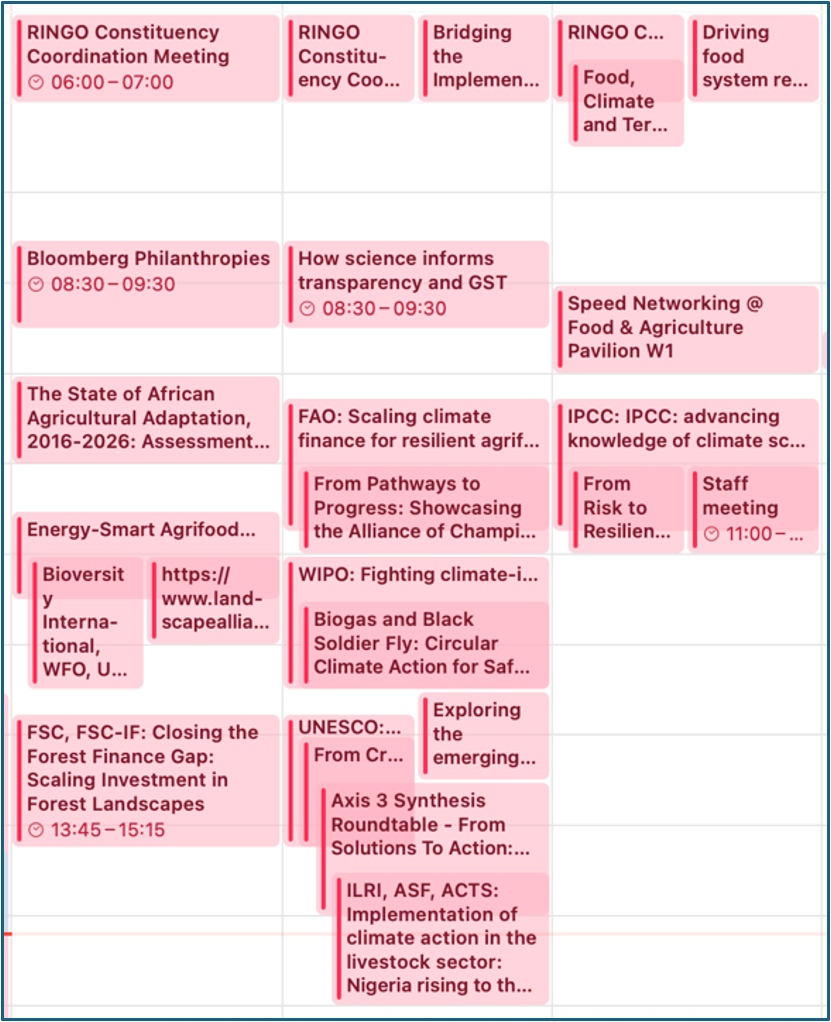
The recent launch of the detailed COP31 app now provides plenty of information about the Pavilions and events in the Blue and Green Zones.
As such I have a rough schedule of activities to attend but I expect that these will change as I learn how COP31 works ‘on the ground’.
It is a small shame that the thematic focus on Day 1 is ‘Food and Agriculture’, which is the most relevant topic to the GPC. However, my impression is that COP31 has a long lead-time so there will be plenty of relevant activities occurring during my time in Antalya.
Sadly I will only have a single day in the Green Zone, as it is closed to regular delegates due to high-level Leader’s meetings on Nov 11-12!
I’m expecting three busy days at COP31….but I only hope that I’m not queuing for too long!