
The Global Plant Council is a coalition of national, regional and international scientific societies, representing over 30,000 plant, crop, agricultural and environmental scientists across six continents. We are an accredited observer organization to the UN Framework Convention on Climate Change. We are non-partisan, and we take positions on the conditions that allow science to serve society.
Ahead of the Thirty-First Conference of the Parties in Antalya and building on the GPC’s standing position on climate change we set out what the plant science community believes the coming decade requires.
Statement: Plants are central to the climate question
Crops and natural vegetation are simultaneously among the systems most exposed to a changing climate and among the most powerful tools available for responding to it. Yields of staple cereals are already measurably affected by heat and drought across major production regions. Photosynthesis is the primary route by which carbon is drawn from the atmosphere, and plant-based
systems underpin food security, soil health, water regulation, biodiversity, fibre, fuel and a growing bioeconomy.
As increasing amounts of carbon are released, the importance of plant carbon assimilation into the 2040s will depend on current foundational research, often in model species rather than in crops themselves. The route from lab-based discovery-science through to a final crop-variety can take decades of work. [1]. The lag is not a figure of speech: the interval between the start of research on an agricultural technology and the point at which the resulting innovation is adopted and raises productivity is estimated at thirty-five to fifty years [2]. Breeding programmes, long-term field trials, germplasm collections and monitoring networks are built on that timescale, through sustained public investment. However, they can be dismantled in a single budget cycle.
The resilience of food systems also depends on the breadth of the utilised crops, not only on the improvement of a handful of staple crops. Neglected and underutilised species, many of them already adapted to heat, drought and poor soils, represent a substantial and largely untapped adaptation resource, and one where the relevant expertise sits disproportionately in low- and middle-income countries [3].
The Problem
Over the few three years, governments across every region have delayed, weakened or withdrawn climate commitments [7-20]. This is not a pattern confined to one country, one political tradition or specific type of policy. Running alongside and much less visible to well-documented global slippage in climate goals, is a retreat from the plant-science research base itself. Public funding for foundational, agricultural and environmental science has been cut or destabilised in several countries, a trend the plant science community has already documented and objected to in its own literature [1]. International collaboration has become harder: researcher mobility is more constrained, joint funding instruments have been suspended, and long-running partnerships between institutions in high- and low-income countries have been interrupted mid-project.
We are also, and separately, losing the ability to see any of this clearly. The international systems that tracked public agricultural research spending have themselves been wound down: the Agricultural Science and Technology Indicators initiative was discontinued in 2023, UNESCO’s series has lapsed, and the remaining collections are updated slowly and unevenly. The most recent years of the best available global dataset are consequently the least reliable, resting heavily on
imputation rather than observation [21]. Governments are reducing investment in agricultural research at precisely the moment the world has stopped measuring it. Whatever view one takes of the spending decisions, no one benefits from making them invisible.
The cost of retreat
The burden of that last effect is not evenly shared. Plant science already shows persistent structural inequities in whose research is funded, published and cited, with scientists in low- and middleincome countries systematically underrepresented in the literature of a discipline whose subject matter concerns them most directly [22]. Disrupting international partnerships does not return research capacity to national borders. It removes it from the places that had least of it to begin with.
We name these examples not to single out any government, but to make plain that this is a global pattern requiring a global response. The consequences are not contained by the borders within which the decisions are taken. Climate does not respect borders. Neither do crop pathogens, drought, or the loss of a generation of trained researchers.
We also note what is being forgone. Public agricultural research is among the highest-returning investments available to a government: internal rates of return are estimated at around 34% in highincome countries and 42% in low-income countries [23]. Plant science has nonetheless long been under-appreciated as an economic proposition relative to the returns it generates [24]. The transition to climate-resilient agriculture and a plant-based bioeconomy is among the substantial economic opportunities of this century. Countries that sustain their research capacity will supply the resilient varieties, the technologies and the expertise that others will need to buy. Retreat from this field is not a saving. It is a transfer of future advantage to somebody else.
For further information contact The Global Plant Council (info@globalplantcouncil.org). We can connect you to the plant science organisations in your region and major plant science centres for further discussions and advice.
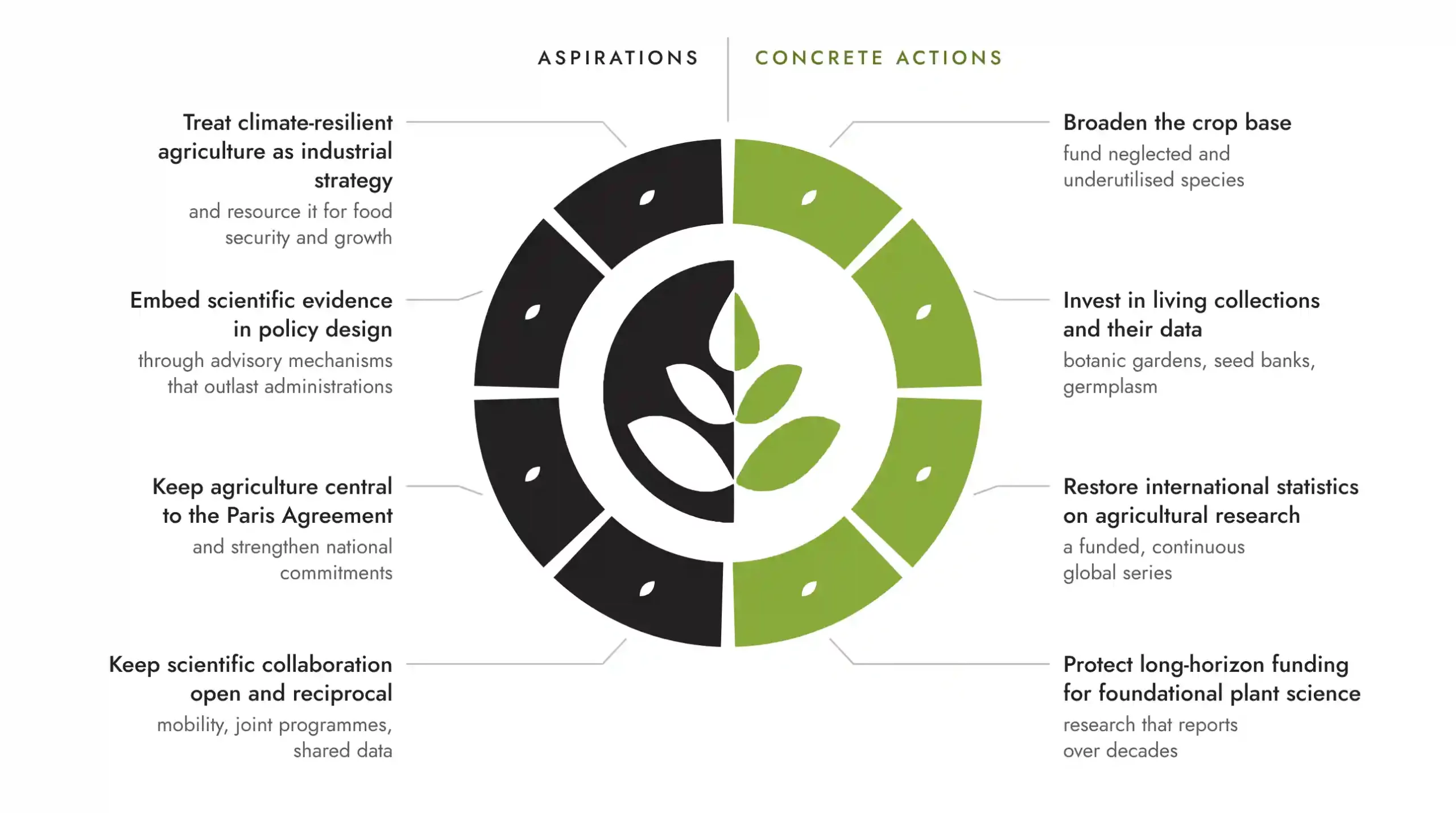
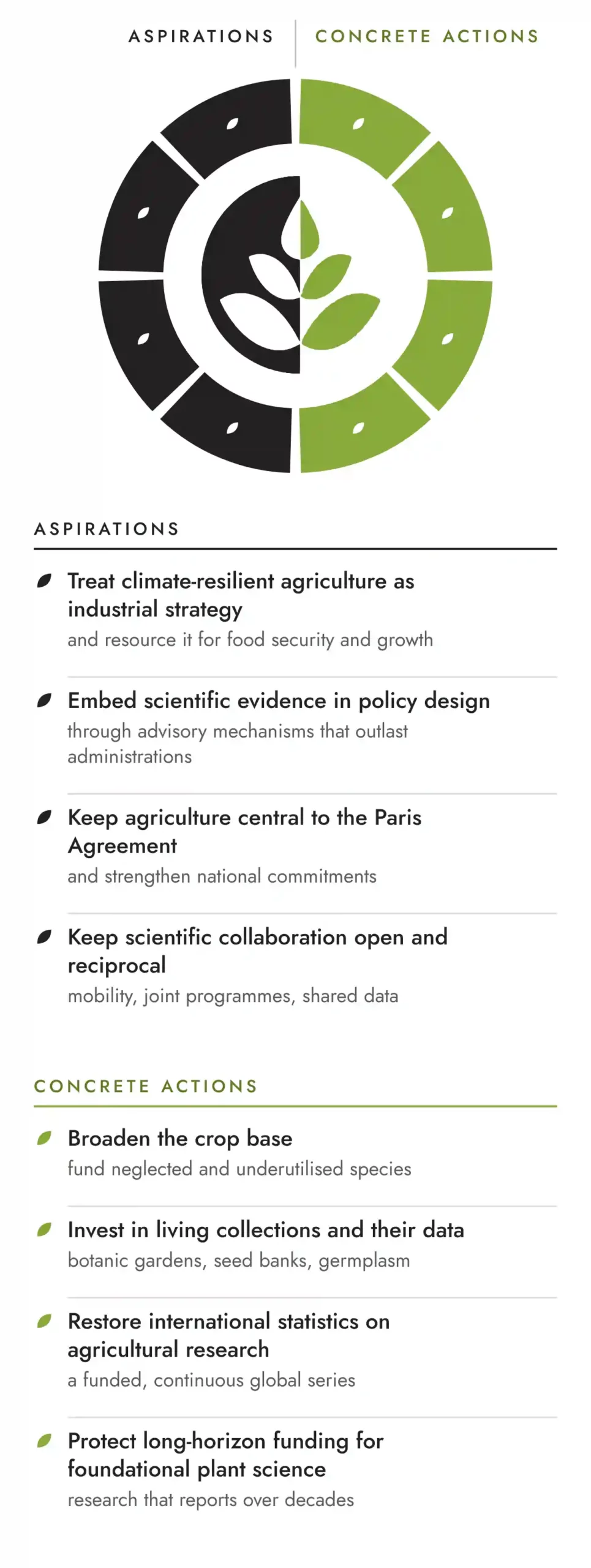
Our Recommendations:
Bibliography
- Friesner JD et al. (2025) Plant Cell 37:koaf106. 10.1093/plcell/koaf106
- Alston JM et al. (2023) Annu. Rev. Resour. Econ. 15:471. 10.1146/annurev-resource-111820-034312
- Padulosi S et al. (2019) Planta 250:709. 10.1007/s00425-019-03169-4
- European Commission (2025) COM(2025) 995 final (CO2 standards, light-duty vehicles)
- European Commission (2026) COM(2026) 616 final (EU ETS amendment)
- Commission Recommendation (EU) 2026/1835 (methane penalties, importers). OJ EU
- Dept. of Finance Canada (2025) Removing the consumer carbon price [backgrounder]. canada.ca
- Liberal Party of Canada (14 Sep 2021) Press release. liberal.ca/?p=33833
- Clean Electricity Regulations, SOR/2024-263. Can. Gaz. II 158(26)
- ECCC (2026) Proposed amendments, LDV GHG Emission Regulations. Can. Gaz. I 160(33)
- Dept. of Finance Canada (2025) Budget 2025, Annex 3
- PMO UK (20 Sep 2023) PM recommits UK to Net Zero by 2050 [press release]. gov.uk
- Sunak R (20 Sep 2023) PM speech on Net Zero. gov.uk
- Alexander H (7 Apr 2025) ZEV Mandate [ministerial statement]. Hansard HC
- DfT (2025) ZEV transition: consultation response. gov.uk
- UN (2025) C.N.71.2025.TREATIES-XXVII.7.d (US withdrawal, Paris Agreement)
- Trump DJ (2026) Presidential memorandum, withdrawal from international organizations. Fed.Reg.91:2281
- UN (2026) C.N.102.2026.TREATIES-XXVII.7 (US withdrawal, UNFCCC)
- EPA (2026) Rescission of GHG endangerment finding. Fed. Reg. 91:7686
- APHA v. EPA, No. 26-1037 (D.C. Cir. 2026)
- van Dijk M et al. (2025) Sci. Data 12:1140. 10.1038/s41597-025-05331-y; data: GRAPE v1.0.0, 10.5281/zenodo.15507361
- Marks RA et al. (2023) PNAS 120:e2217564120. 10.1073/pnas.2217564120
- Rao X et al. (2019) World Dev. 122:27. 10.1016/j.worlddev.2019.05.009
- Zilberman D (2019) Global Plant Council Blog. globalplantcouncil.org
- Brockington SF et al. (2026) Nat. Plants. 10.1038/s41477-025-02192-6https://doi.org/10.1093/jxb/erab256
About The Global Plant Council
The Global Plant Council is a coalition of 20 national, regional, and international organizations representing plant, crop, agricultural, and environmental sciences across the globe. GPC aims to promote plant science across borders & disciplines, supporting those involved in research, education, and training, and to increase awareness of plant research in science and society. Find out more.