

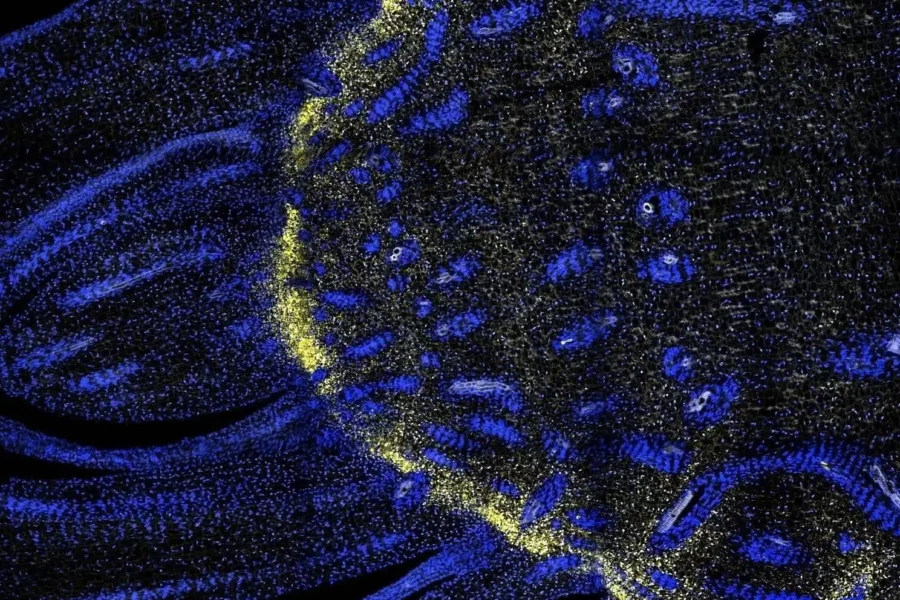
Image: This award-winning image by Brandon James, Project Manager in the Swaminathan lab at the HudsonAlpha Institute, shows a thin slice of part of a Sorghum bicolor shoot apex. The fluorescent probes show cells in the shoot (nuclei labeled in blue) and the expression of RNA transcripts of a gene called KNAT1 (yellow). This is part of work by CABBI and its partners to better understand different cell types within sorghum stems and enable cell-type-specific engineering for bioenergy and novel bioproducts. Credit: Center for Advanced Bioenergy and Bioproducts Innovation (CABBI)
New resource pinpoints inner workings of sorghum plant cells for designing better bioenergy feedstock AgricultureNews

New resource pinpoints inner workings of sorghum plant cells for designing better bioenergy feedstock

Researchers have developed a new resource to better understand sorghum plant cells, enhancing its use as a bioenergy feedstock. By identifying gene expression patterns in sorghum stems, they aim to create more resilient, productive plants. This advancement could lead to…
Isabel
27/06/2024
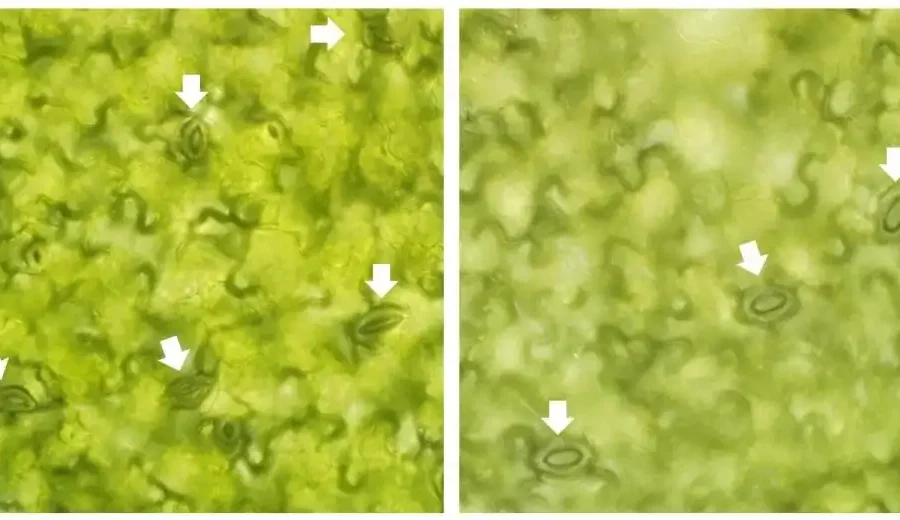
Image: Images of leaves of the model plant Arabidopsis thaliana with stomata mainly closed (left) and open (right) (marked with arrow heads). Credit: CRAG
Understanding plant breathing: Identification of the key protein interplay behind rhythmic stomatal movements  NewsPlant Science

Understanding plant breathing: Identification of the key protein interplay behind rhythmic stomatal movements 

Researchers discovered the interaction between proteins PIF and KAT1, essential for stomatal rhythmic movements in plants. This mechanism controls stomata opening in the day and closing at night, vital for photosynthesis and water regulation. This knowledge aids in enhancing crop…
Isabel
24/06/2024
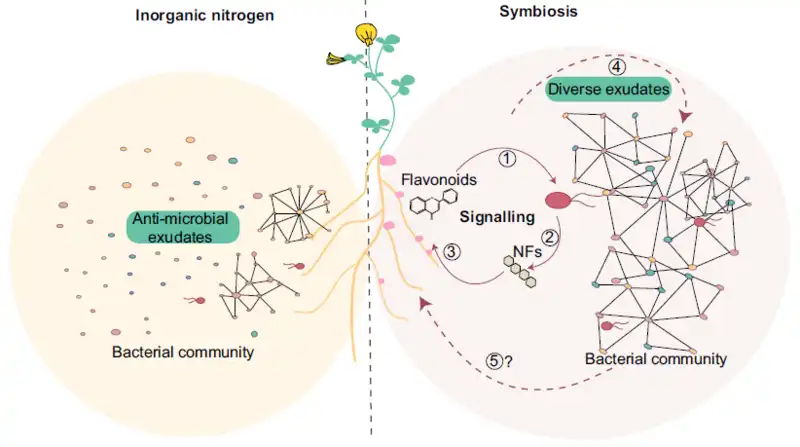
Image credit: Nitrogen nutrition and signaling during root nodule symbiosis impact the community assemblies. Lotus plants grown in the presence of inorganic nitrogen secrete specific metabolites and assemble a microbial community with low connectivity. Lotus plants grown in symbiosis-permissive conditions secrete metabolites such as flavonoids (1) that induce Nod factor production in compatible nitrogen-fixing Rhizobiumisolates (2). Nod factors are recognized by the Lotus host which initiates a signaling pathway (3) to accommodate the symbiont. Symbiotically active roots have an exudate profile (4) and associated microbial communities that differ from plants grown in the presence of inorganic nitrogen. It remains to be determined how bacterial communities associated with symbiotically active plants impact the host to promote the symbiotic association and plant growth (5). Figeure: from Ke Tao et al. 2024)
A new study reveals key role of plant-bacteria communication for the assembly of a healthy plant microbiome supporting sustainable plant nutrition AgricultureNewsPlant Science

A new study reveals key role of plant-bacteria communication for the assembly of a healthy plant microbiome supporting sustainable plant nutrition

Researchers found that specific molecules enable symbiotic bacteria to communicate with legume plants, influencing bacterial growth near roots. This signaling fosters beneficial partnerships for nutrient uptake and resilience, crucial for sustainable agriculture. The study highlights the role of plant-bacteria communication…
Isabel
21/06/2024