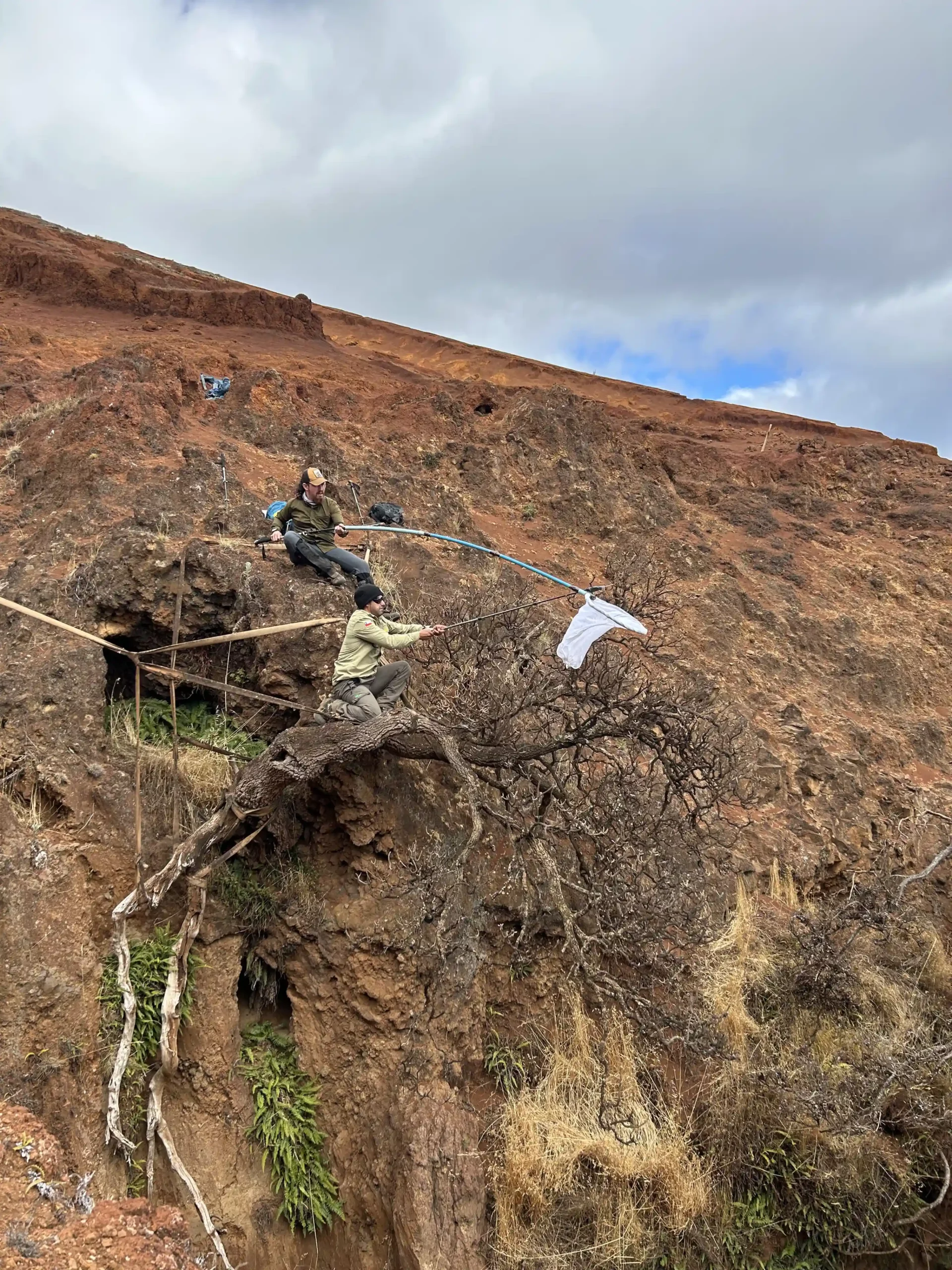
- Endemic to Robinson Crusoe Island, Chile, this Critically Endangered plant is represented by just one individual on the side of a cliff
- The Millennium Seed Bank (MSB) at Kew Wakehurst has received 29 seeds from the last known Dendroseris neriifolia tree in the world
- Eight seedlings have germinated at the MSB, of which three will soon be transferred to Logan Botanic Garden (LBG) in Scotland
- Global collaborative effort between seed banks, botanical gardens, funders and government agencies highlights the importance of partnerships for conservation
- Kew’s scientists are racing against time to test seed viability, germination and cultivation methods, helping prevent the species’ global extinction
Conservationists are in a race against time to prevent one of the world’s rarest island plants from disappearing forever, after seeds collected from the only surviving wild Dendroseris neriifolia tree arrived at the Millennium Seed Bank (MSB) at Kew Wakehurst in Sussex in April 2026.
Endemic to Chile’s remote Juan Fernández Islands, the critically endangered tree daisy has been reduced to a single known wild individual after decades of habitat loss, invasive species and failed recovery efforts. Scientists are turning to ex-situconservation by beginning emergency germination trials that may represent the species’ last realistic chance of survival, with the hope of growing plants to maturity and securing seeds for long-term conservation.
X-ray analysis on the newly arrived seeds at Kew’s MSB has revealed that 25 of the 29 seeds sent to Kew are potentially viable, highlighting both the rarity of the species and the importance of securing healthy seed material. To maximise the chances of long-term survival, the seeds have been carefully divided between conservation and propagation efforts. Eight seedlings are now establishing, of which three will soon be sent to LBG, Royal Botanic Garden Edinburgh.
Once concentrated in ravines and low-lying areas on Robinson Crusoe Island, D. neriifolia declined dramatically; by 1980, only eight surviving wild individuals remained. As the population continued to decline, the species was identified as a high conservation priority during the 1990s, prompting intensified recovery efforts by CONAF Park Rangers. Despite reintroduction efforts in the early 2000s, the breakdown of protective measures in 2017 allowed invasive species to enter the site, leaving just one tree in the wild today, and an ex-situ collection established at the National Botanical Garden of Chile failed due to climatic conditions. There is, however, currently one young specimen growing in VerdeNativo botanic gardens.
Recovery has been further complicated as 90% of seeds are non-viable owing to geographical isolation, while individuals in gardens suffer from hybridisation meaning their seed cannot be used. These failed conservation effort underscore how fragile the species’ recovery remains, and how narrow the window for intervention has become.
Richard Baines, Curator of Logan Botanic Garden said: ‘This is a significant moment in the ongoing conservation relationships between Logan – and the wider Royal Botanic Garden Edinburgh – and key colleagues in the UK and in Chile.
‘For more than 40 years we have been strengthening partnerships with plant scientists and horticulturists in Chile. Experience has shown us that species from the Juan Fernández Islands feel particularly at home here at Logan, on the southwest tip of Scotland, bathed by the soft air of the Gulf Stream. While providing a safe haven for these endangered plants, and learning more about their adaptation to different environments, we also have an important opportunity to tell the story of Dendroseris neriifolia and its amazing natural habitat in the South Pacific Ocean. By engaging with our visitors, we can inspire them to play their part making change for the better. It is an exciting time.’
Diego Penneckamp, scientist at Jardín Botánico VerdeNativo, author of the Flora Vascular Silvestre del Archipiélago Juan Fernández (2018) said: ‘It is a race against time. This international collaboration to support the last remaining individual could prevent the extinction of a species that represents a unique lineage with its own natural history.’
The Juan Fernández Islands, located 760 km off Chile’s coast, are a global biodiversity hotspot, with an estimated 1.7 endemic species per km². Around 65% of their plant species are found nowhere else on Earth, and the archipelago supports 97% of Chile’s endemic fish species and 45% of its endemic bird species.
The entire genus of Dendroseris (known as ‘cabbage’ trees) is exclusively found on the Juan Fernández Islands, and they are the only plants in the world known to feature unusual, rare ‘tree-daisy’ forms with daisy-like flowers atop a woody, branching trunk. The pressures these plants face include widespread forest clearance and intensive grazing by introduced mammals. Invasive plants also suppress endemic vegetation, while repeated fires have further destabilised already vulnerable habitats.
With such unique biodiversity comes irreplaceable ecological interactions. One endemic species that relies on Dendroseris flowers is the Critically Endangered Juan Fernández firecrown hummingbird. Without these plants, we would see catastrophic effects on these vital plant-pollinator interactions and the fragile ecosystem in which it exists.
Collecting the seeds is no easy task due to the tree’s extreme location. Clinging to the side of a steep cliff on Robinson Crusoe Island, D. neriifolia tree is supported with ropes to prevent it from falling. Working in precarious conditions, collectors carefully climb along the length of the trunk to reach the flowering branches, where mature seeds are captured in nets. Seed collection takes place each March, when the one-seeded fruits are fully mature and ready for harvest. This year, a total of 400 seeds were collected.
Felipe Sáez, a Plant Biotechnology Engineer and administrator of PNAJF said, ‘The Juan Fernández Archipelago has the highest density of endemic plant species per km² in the world, yet it is also among the most vulnerable due to the multiple drivers of ecosystem degradation affecting the territory. Most notably, the percentage of species classified as threatened according to the IUCN increased from 45% to 88% over the past 30 years. Within the genus Dendroseris, six species are currently classified as Endangered, four as Critically Endangered, and one as Extinct in the Wild. The successful transfer of these seeds represents one of the most significant collaborative efforts to safeguard the flora of Juan Fernández and is the result of an international partnership led by Jardín Botánico VerdeNativo, together with the National Forest Corporation (CONAF) through Parque Nacional Archipiélago Juan Fernández (PNAJF). In addition to D. neriifolia, the teams have also facilitated the transfer of seeds from two additional Dendroseris species from Robinson Crusoe Island: D. litoralis and D. pruinata. Both species will undergo germination and propagation trials at Logan Botanic Garden and Kew Wakehurst.’
Paulina Hechenleitner, Research Associate at the Royal Botanic Garden Edinburgh, an authority on the conservation of Chilean plants and Science Leader at Jardín Botánico VerdeNativo, said: ‘It was an enormous effort involving the entire project team in Chile at different stages to enable me to safely bring the seeds to the UK. Seeing this species germinate here in the UK demonstrates the strength of international collaboration and long-term partnerships in conservation. It highlights how essential these collective efforts are in preventing extinction and securing a future for some of the world’s rarest plant species.’
At Kew, eight seeds are being used in germination and cultivation trials to better understand the conditions needed for seedling survival and to grow plants to maturity for future seed production. Eight seedlings are now starting to germinate, and once old enough three plants will be shared with Logan Botanic Garden through the Critically Endangered species pipeline project. The remaining seeds will be placed into long-term conservation storage at the MSB, providing a vital safeguard against the species being lost forever in the wild or during cultivation efforts.
RBG Kew’s Seed Processing Manager Sarah Gattiker and Botanical Horticulturalist Alice Livingstone explained: ‘Following X-ray analysis and germination tests, together with the invaluable horticultural advice from Felipe Sáez Quintana and Gonzalo Rojas Sea, CONAF, we made the decision to direct sow the seeds into compost in the glasshouses at Wakehurst. This reduced the risk of the seedlings being exposed to too high humidity on the laboratory agar plates and minimised seedling disturbance, therefore hopefully leading to the highest potential seedling development for this species. Through this collaborative effort all eight seedlings have now germinated.’
Seed collectors from CONAF aim to send another seed collection to the UK next year to strengthen the programme further. With so few potentially viable seeds remaining, specialist expertise in seed conservation, germination science and ex-situ propagation will be critical to securing the species’ future.
This project has been made possible thanks to the Mohamed bin Zayed Species Conservation Fund (project number 252540297).
Article source: Royal Botanic Gardens, Kew
Image: Experts collecting the seeds of the last known specimen D. neriifolia on Robinson Crusoe Island, Chile. Its seeds have been sent to the Millennium Seed Bank in the UK for safeguarding and conservation. Credit: Gonzalo Rojas